Loading your local notes…
No cases saved in this browser.
Start with one case to organize your clues. The case title is your own label, not an official mission name.
Selected case
Suspects
Observations and theories
No claims are currently marked unresolved. This does not mean the case is solved.
Revisit a previous case
Open any case saved in this browser. Old statements remain available until you delete the case or clear browser storage.
Create a case
Give the case a name you will recognize, such as “Office region — clock clue”. The name is your own label, not an official mission title. Create a case, add a suspect, then add one observation at a time.
- Case name: A name only you will see.
- Suspect: Use the card number or name visible in your own case.
- Displayed role: What the suspect appears to be, not necessarily their true role.
- Exact clue: Write what was actually said or shown before interpreting it.
- Evidence origin: Dialogue, Role card, Board event, Player note, or Other.
- Evidence status: Observed, Inferred, Unresolved, or Contradicted.
- Reason: What other observation supports or conflicts with this?
The tool includes add, edit, and confirmed-delete actions, along with JSON and readable-text export. It does not import notes or declare a case solved.
A three-pass way to use the notebook
Pass 1 — Observe. Note the exact statement and who made it. “Suspect 4 claims the role of Therapist” is an observation; “Suspect 4 is honest” is a conclusion. Keep them separate.
Pass 2 — Test. Add a second clue or event that could support or contradict the first. If two suspects display the same role, note both claims before assuming either is lying. Dupery contains roles that can affect apparent identity, so duplicate displays are a reason to investigate, not an automatic verdict.
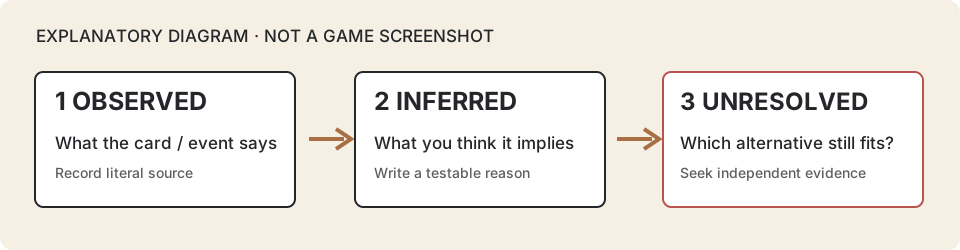
Pass 3 — Decide. Before arresting, open your unresolved claims. Which conclusion rests on one source? Which is supported by independent observations? If a key assumption still has two plausible explanations, state that uncertainty rather than hiding it.
A practice example — invented to demonstrate the tool, not a walkthrough
- Suspect A: displayed role “Good Cop” — Observed (card display, as typed by the user).
- Suspect B: displayed role “Good Cop” — Observed (card display, as typed by the user).
- “A must be the real Good Cop” — Unresolved inference.
- Next step — “Find an independent event or role effect that separates the two explanations.”
This example does not encode a solution to any real Dupery case. It demonstrates why recording apparent roles and verified alignment separately is useful.
Review a case later
Your in-game board is useful while a case is open. An external record can serve a different purpose: keep the exact statements you typed, your early theories, and any later corrections together after you finish playing. Return to an earlier case from Your cases to inspect why you reached a conclusion, even if you cannot recreate every clue from memory. This notebook records only the information you enter; it cannot recover statements you forgot to copy.
One player asked for a way to revisit statements after the end-of-case Reveal All screen in a September 2026 Steam discussion. That is a documented player request, not evidence that the October full-release build lacks such a feature. See the original Steam discussion.
Practical review: Open the earlier case, filter Unresolved or Contradicted, read each original clue before its reason field, then export readable text if you want a permanent case summary. Keep conflicting versions instead of deleting the earlier observation.
What the notebook cannot do
It cannot see the game’s hidden alignments, guarantee a solvable case, confirm a role from a screenshot, or know whether a patch changed a mechanic. It is a thinking aid, not an automated solver or an official companion app.
Notes and data
Notes are saved in this browser’s local storage. Clearing browser storage or using another device may make them unavailable. Export your case when you want a backup. The site does not require registration, and the notebook does not send your notes to a server or third-party analytics. Site-wide Google Analytics and the Steam embeds on game hubs are described on the Privacy page.
Related help
Having trouble with identical-looking roles? Read Conman vs Copycat. Wondering about alignment conversion? Read Good Cop vs Bad Cop. For confirmed product information, consult the official Steam page.