Why the distinction is difficult
The game’s premise makes deception part of normal play: identities can be obscured by role effects, and not every misleading appearance has the same cause. In a Steam discussion specifically about Conman, a player described a case with several suspects showing the same innocent role and reported that the available information seemed insufficient to identify the threat safely.
The discussion did not settle a universal answer. Some participants argued that auxiliary roles such as Mathematician, Researcher or Weatherman can add identifying evidence. Others debated whether a particular board could have been resolved before another role was arrested. The debate is useful because it shows how much the order and availability of evidence matter.
A practical check before you accuse anyone
1. Record every displayed role without treating display as identity. Put the suspect number, what the card appears to say and any claim the suspect makes into separate notebook fields.
2. List plausible explanations. Could multiple displays arise from a disguise or copying effect? Mark this as a hypothesis until a relevant rule or observed event narrows it down.
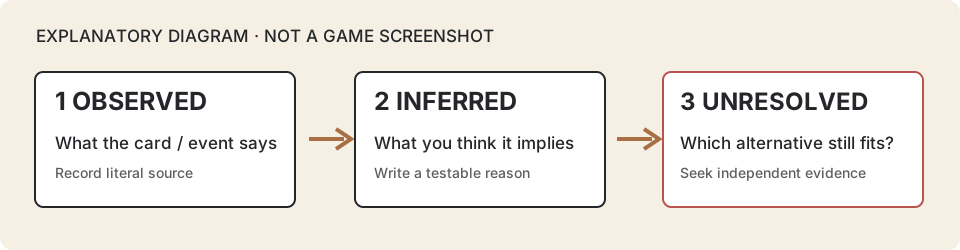
3. Look for a genuinely independent check. A different role’s information, a location-based effect, or an event whose trigger you can verify may distinguish two theories. Do not assume a named role will always be available in your randomly generated case.
4. Check timing and irreversibility. If your planned arrest removes a source of future information, ask whether a non-destructive observation could answer the question first. A poster’s disputed example involved exactly this kind of information-loss debate.
5. Stop when the evidence stops. If two explanations fit all the facts you’ve confirmed, record both. A guide that tells you to arrest a specific numbered suspect without seeing your actual board would be guessing.
Worked reasoning pattern — not a real case solution
Imagine suspects A and B both display the same innocent role. That is one observation, not a solved identity. Suppose a third source tells you only that one of them has a certain alignment, but you cannot verify whether that source has been affected by another role. You now have two uncertainties: the suspect’s identity and the reliability of the third source. A good notebook records those separately. It does not upgrade “one statement seems consistent” to “Conman caught”.
This is an illustrative reasoning exercise, not a claim about a specific generated board or guaranteed game mechanic.
What the community thread does and does not establish
Supported: At least one player experienced a duplicate-role situation involving Conman and Copycat and found it hard to distinguish suspects; several commenters proposed other role interactions or timing-dependent strategies.
Not established: That every such case is logically impossible; that any single trick works in every version; or that the particular commenter debate is an official ruling.
The right response to unresolved evidence is to identify the next useful observation. That is what the Case Notebook is for.
FAQ
Can duplicate cards prove one player is the Conman? No. Duplicate appearances alone do not uniquely identify the source of the disguise. You need independent evidence about the role or alignment in the specific case.
Does a Conman/Copycat board always create a 50/50 guess? Not necessarily. The thread includes both reports of ambiguous positions and suggestions that information from other roles or earlier events can break the tie. There is no verified universal rule here.
Should I arrest as soon as I spot matching roles? Not as a general rule. A wrong arrest can cost reputation; preserve evidence and consider whether waiting or another observation would narrow the possibilities.
When to revisit this answer
The cited player report predates the October 15 full-game launch. This page records a single community dilemma, not an independently verified full-release mechanic; check the role text in your current build and treat the scenario as unresolved.
The developer’s press kit contains official game screenshots, but this page does not rehost them because a monetized independent-site image license was not documented. See the official Dupery image source and player-shared image if you need visual context; neither image proves a Conman solution.
References
Dupery Steam storefront · Original Conman discussion · Dupery source notes